
Many organizations lose talented employees because workplace culture suppresses initiative and excellence. In Kenya, new hires often enter systems that normalize complacency and resistance to change. This article explains how toxic team dynamics affect performance and how organizations can rebuild an ownership culture.
It happens in almost every major organization across Kenya. A company opens up a competitive recruitment process, sifts through hundreds of CVs, conducts rigorous interviews, and finally hires the perfect candidate.
This new employee arrives on Monday morning bursting with fresh ideas, a hunger to perform, and an innate desire to improve broken systems. They have fire in their eyes and initiative in their stride.
But as they settle into their desk, an older colleague leans over, smiles knowingly, and whispers the most dangerous phrase in Kenyan corporate culture:
“Tulia tukufunze kazi, kijana. Wewe ni wa juzi. Tulia upangwe.”
Relax, let us teach you how we actually work here. You just arrived. Calm down and fit in.
On the surface, it sounds like harmless, friendly hazing. But in reality, it is the beginning of an aggressive cultural decline. Within six months, that brilliant new hire’s fire completely disappears. They stop suggesting ideas, they stop volunteering for projects, and they fade into the background.
The employee didn't suddenly become lazy. The culture simply assimilated them.
Why Excellence Becomes Socially Uncomfortable
High-performing employees do not lose their motivation because they lack stamina; they lose it because the workplace culture actively punishes initiative while quietly rewarding complacency.
When a toxic underlying culture dominates an office, doing "too much" makes the rest of the team look bad. Excellence becomes socially awkward. The motivated worker is labeled a "show-off" or an "overachiever" by peers. Over time, the pressure to conform becomes exhausting, learned disengagement sets in, and mediocrity is embraced as the safe, comfortable baseline for daily survival.
According to global data from Gallup, disengaged workplace cultures aggressively tank productivity, stifle innovation, and drive away an organization's top-tier talent. Culture always wins the battle against individual motivation. It trains your people toward one of two things: excellence or survival.
The Three Types of People on Your Payroll
During a recent leadership strategy session with my colleague Executive Coach Duncan, a profound principle emerged regarding how human dynamics naturally divide within any Kenyan workforce. Every organization houses three distinct groups:
1. The Leaders
These are the sparks. They don't wait for a formal title or a management promotion to care about the company’s bottom line. They take radical ownership, solve problems before they escalate, and naturally push the culture toward excellence.
2. The Laggers
These are the fence-sitters. They do the bare minimum required to secure their salary and actively avoid taking risks. The Laggers are highly influenceable. If your company culture is defined by strong, vibrant leadership, they step up and perform beautifully. But if the office culture is toxic, they sink right down into the mud with everyone else.
3. The Leavers
These individuals have completely checked out emotionally, but they remain firmly anchored on your payroll. They complain constantly, aggressively resist any operational changes, and actively poison the minds of motivated staff. These are the people using the company Wi-Fi to apply for other jobs while telling your enthusiastic new hires to “tulia upangwe.” This third group is incredibly dangerous because negativity spreads socially far faster than excellence ever does.
Leadership is an Attitude, Not a Title
True ownership culture means breaking the myth that only managers are responsible for the company’s success.
There is a legendary historical story from NASA that illustrates this perfectly. During a visit to the space center in 1962, President John F. Kennedy walked past a janitor carrying a mop. JFK paused and asked the man what he was doing. The janitor didn't reply with his job description. He looked the President in the eye and said: “Mr. President, I’m helping put a man on the moon.”
That janitor didn't have a title, but he possessed the ultimate leadership mindset. He understood the macro-mission, recognized his exact contribution to it, and took absolute pride in his role. Strong corporate cultures create this exact line of sight for every single employee, from the boardroom to the front gate.
How HeartSpark Consultancy Rebuilds the Line of Fire
When we partner with corporate leaders at HeartSpark Consultancy, we don't just run a standard motivation session. We enter the trenches to disrupt the toxic peer dynamics that are killing your high performers. We design interventions that force organizations to take three critical steps:
- Protect the Sparks: Your high-performing, enthusiastic employees must be deliberately insulated from toxic peer influence. If you leave your best people unprotected in a cynical environment, the environment will eventually break them.
- Activate the Laggers: We push the passive fence-sitters to get off the sideline. A passive, quiet culture cannot sustain high performance; the middle group must be challenged to actively choose the path of excellence.
- Expose the Leavers: Leadership must stop allowing emotionally disengaged, cynical employees to quietly dictate the office culture. Unchecked negativity is a virus that will rot your organization from the inside out.
The Hard Truth
If your veteran employees are currently teaching your new hires how to be lazy, how to avoid accountability, and how to stay silent, then your culture is successfully training your people in the wrong direction.
Because make no mistake—your culture is always teaching something. Every single day, a curriculum is being run in your office.
The real question you need to ask yourself as a leader is: What are my people actually learning?
Frequently Asked Questions
Why do top-performing employees quit or lose their drive so quickly?
Top performers lose momentum when they realize their initiative is met with bureaucratic resistance, peer resentment, or a leadership team that rewards compliance over genuine impact.
How can a business identify "The Leavers" before they ruin team morale?
Leavers are identified by chronic cynicism, active resistance to organizational improvement, and a distinct habit of discouraging newer, highly motivated team members.
What is the best way to cultivate leadership without a title?
Leaders can cultivate this by clearly communicating the company’s larger vision, mapping how every single role contributes to that vision, and rewarding employees who proactively solve problems outside their strict job descriptions.
Why do motivated employees lose energy at work?
Motivated employees lose energy when workplace culture discourages initiative, rewards complacency, and punishes innovation.
What is toxic workplace culture?
Toxic workplace culture is an environment where negativity, disengagement, poor accountability, and resistance to growth become normalized.
How can organizations retain high performers?
Organizations retain high performers by protecting initiative, encouraging ownership, and building cultures that reward contribution and accountability.
What is leadership without a title?
Leadership without a title means taking responsibility and contributing to organizational success regardless of job position.
Why is organizational culture important?
Organizational culture shapes employee behavior, motivation, communication, and long-term business performance.
Author Block
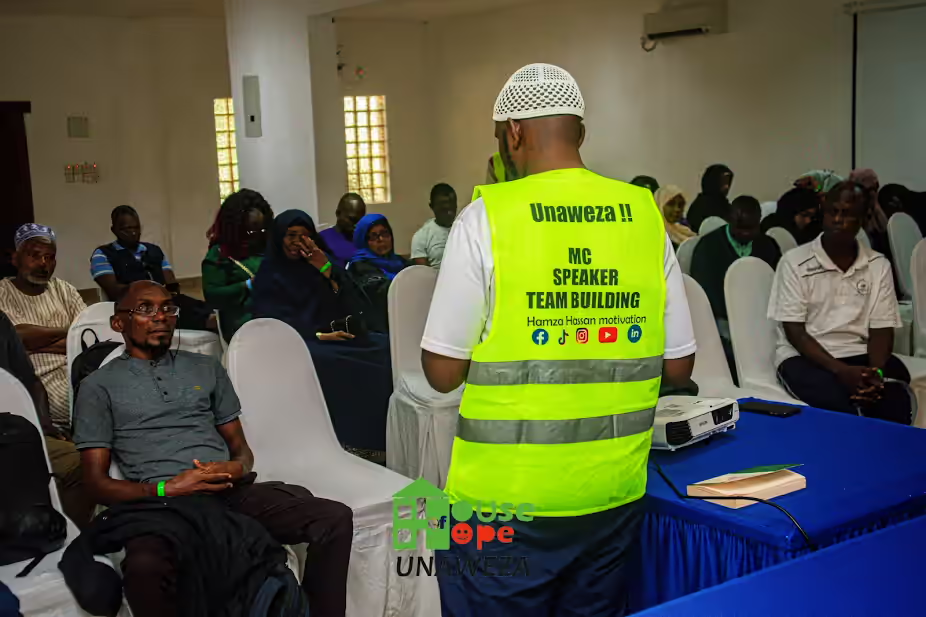
Hamza Hassan is the Founder of HeartSpark Consultancy. As a corporate trainer, culture consultant, and professional Master of Ceremonies, he helps service-driven organizations eliminate toxic compliance, protect their top talent, and build high-performance ownership cultures.
Let’s protect the fire in your team.
Conclusion
Organizations lose high-performing employees when workplace culture normalizes disengagement and suppresses initiative. Companies that intentionally build ownership culture, protect motivated employees, and reinforce accountability create stronger, more resilient teams capable of sustaining long-term performance.