A close friend of mine once shared a leadership lesson that completely reframed how I look at organizational dynamics.
Early in his career, his very first boss handed him a simple, ten-word philosophy to use whenever he uncovered new data, corrected a misstep, or evolved his perspective on a project:
“I was wrong before. I’m smarter now.”
It is a deceptively simple sentence, but it carries a massive weight. Most professionals do not struggle with the intellectual capacity to learn new things. Instead, they struggle with the emotional capacity to admit that what they knew before was insufficient.
And that exact friction point is where the most toxic organizational culture crises begin.
The True Cost of a Rigid Leader
Many leaders draw a false equivalence between admitting an error and losing their professional authority. They operate under the outdated assumption that to lead means to be permanently flawless. Consequently, when a strategy begins to fail or an internal system breaks down, their natural defense mechanism is to double down on an obsolete idea.
They choose rigidity over reality because admitting an error feels incredibly uncomfortable, changing one's mind is falsely equated with weakness, and hiding behind the shield of being "right" feels infinitely safer than remaining curious.
But a leadership style built entirely on ego is an expensive liability. True, sustainable leadership is never defined by stubborn rigidity; it is defined by agile adaptability.
Dismantling the Performance of Perfection
When a leader has the courage to stand before their team and say, “I was wrong before. I’m smarter now,” they instantly strip the ego out of the growth process.
That single statement reframes a mistake from a punishable offense into an evolutionary milestone. It completely shifts the emotional climate of the workplace. When leadership normalizes the act of learning out loud, employees stop wasting precious energy hiding their mistakes, falsifying reports, or deflecting blame. Instead, they start contributing with absolute honesty.
The vast majority of corporate bottlenecks are not intelligence problems—they are flexibility problems. Too many executives would rather defend a disastrous, cash-bleeding decision to protect their personal image and maintain top-down authority than utter five words: “There may be a better way.”
The Japanese have a classic, timeless proverb: “A wise person changes his mind. A fool never does.” Growth requires an ongoing, systematic update of your beliefs whenever fresh evidence appears. Refusing to pivot in the face of new reality isn't strength. It is stagnation.
The Birth of Emotional Danger
When a leader treats their own infallibility as law, the organization becomes an emotionally unsafe place to work. The sharpest minds on your payroll will quietly stop sharing innovative ideas, stop challenging flawed decisions, and stop giving honest feedback.
They don't stay silent because they lack insight; they stay silent because they know that offering feedback to an insecure leader is a quick way to get marginalized, dismissed, or penalized.
Mark Twain once wrote with his trademark bluntness: “No amount of evidence will ever persuade an idiot.” While those words are harsh, they point to an undeniable truth in organizational development: Some leaders are not limited by a lack of intelligence. They are limited by an unhealthy, desperate attachment to being right. Over time, that mindset completely rots corporate trust.
What Humble Leadership Actually Builds
Humble leadership is the foundational pillar of Psychological Safety. When leaders openly own their growth and acknowledge their missteps, they embed a powerful set of unwritten rules into the company culture:
- Learning matters significantly more than looking perfect.
- Mistakes are survivable, diagnostic events, not career-ending failures.
- Strategic curiosity is actively welcomed, and raw feedback is entirely safe.
As proven by Google’s famous Project Aristotle research, psychological safety is the single most accurate predictor of high-performing, high-execution teams. Teams scale exponentially faster when individual members feel safe enough to think openly and flag risks early. Without this psychological safety, employees become deeply defensive. They stay silent, avoid calculated risks, conceal critical errors, and spend their days protecting themselves emotionally rather than driving the business forward.
The Ultimate Leadership Shift
Something remarkable happens to a team's performance when a leader models true humility. The corporate armor drops. The team naturally becomes more innovative, more transparent, and fiercely collaborative because humility is the only soil in which genuine organizational trust can grow.
The hard truth is this: Leadership is never about always being right. It is about being fully committed to evolving.
Many organizations in Kenya and across the globe are not struggling because their staff lacks talent, drive, or capability. They are struggling because the leadership ego has made learning an unsafe activity.
Sometimes, the most dominant, high-yielding tool in an executive's arsenal is not their positional authority. It is their humility.
Frequently Asked Questions
Why is leadership humility considered a competitive business advantage?
Humility allows leaders to remain objective, receive critical market feedback, intercept operational errors before they become catastrophic, and build high-trust cultures that attract and retain top talent.
How does a leader's inability to admit mistakes affect employee retention?
High performers refuse to work in environments where their expertise is stifled by a manager's ego. When leaders refuse to admit errors, top talent quickly disengages and exits the organization.
What practical steps can a leader take to build psychological safety tomorrow?
Start by actively soliciting feedback in meetings, publicly thanking employees who point out flaws in a strategy, and openly sharing the lessons learned from your own past professional missteps.
Author Block
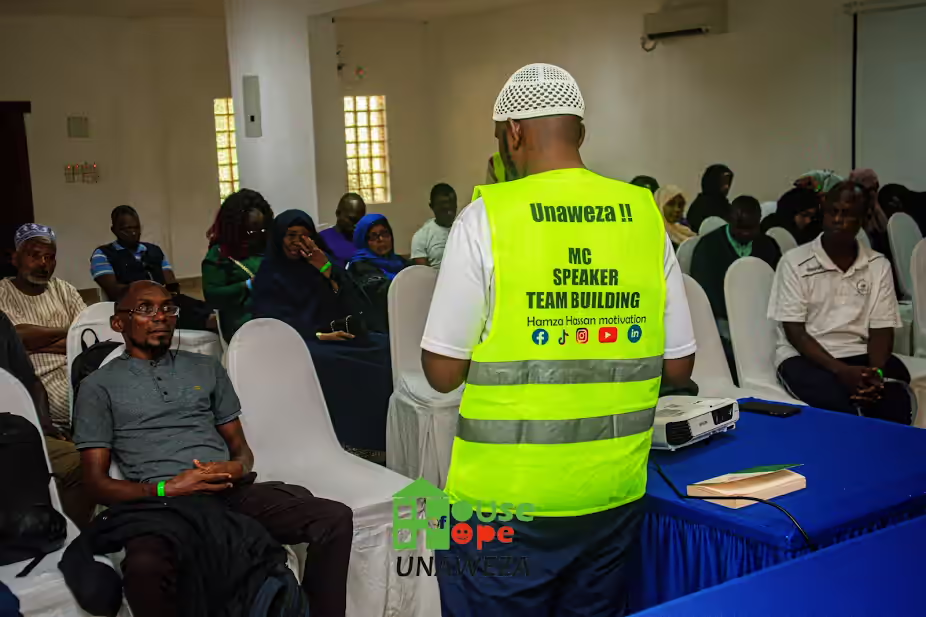
Hamza Hassan is the Founder of HeartSpark Consultancy. As a corporate trainer, culture consultant, and professional Master of Ceremonies, he helps service-driven organizations break through leadership bottlenecks, eliminate ego-driven dysfunction, and build high-performance ownership cultures grounded in psychological safety.
Let’s build a culture that values truth over ego: houseofhopeinspiration@gmail.com